MBBS Abroad Without NEET 2026: Rules, Reality & Career Paths
The dream of becoming a doctor doesn't end with a disappointing NEET score. But the path abroad is riddled with traps, half-truths and consultants who care more about your wallet than your career. Here's the truth, all of it.
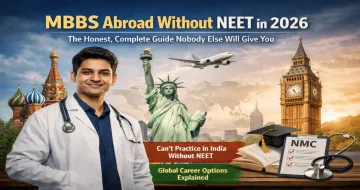
You can enroll in MBBS programs abroad without NEET. Several countries and universities will happily admit you. However, as per the National Medical Commission (NMC), if you did not qualify NEET before enrolling, you cannot practice medicine in India after completing your degree. The two things admission abroad and the right to practice in India are entirely different.
Why This Question Is More Complicated Than You Think
Here's where most articles lose you: they treat "MBBS abroad without NEET" as a single, clean answer. It isn't. The question actually contains at least three separate questions hidden inside it.

First: Can I get admission to a foreign medical university without a NEET score?
Yes, in many countries.
Second: Will my degree be recognised in India?
Only if you had a valid NEET score before enrolling and only if the university meets the NMC's updated 2026 standards.
Third: Can I still become a practicing doctor somewhere in the world without NEET?
Yes, but the pathways are harder, longer and far less certain than a glossy brochure will tell you.
Once you understand that these three questions exist independently, the entire conversation changes.
"The consultancy that tells you 'don't worry about NEET' is the same one that won't take your calls two years later."
What the NMC Actually Says in 2026
The National Medical Commission has tightened its rules considerably. The updated Foreign Medical Graduate Licentiate (FMGL) Regulations are no longer suggestions they are the gate through which every foreign-educated Indian doctor must pass to practice at home. Here is what they require:
NEET qualification is mandatory for Indian practice
Any Indian citizen or Overseas Citizen of India (OCI) who obtained a foreign medical degree on or after May 2018 must have qualified NEET-UG before enrolling. The NEET score is now valid for three years, giving students some flexibility around visa delays and late admission cycles.
Minimum 54 months of academic study
Programs shorter than this will not be recognised. This includes pre-medical or language foundation years, the actual medical curriculum itself must be at least 54 months long.
12-month internship at the same institution
The internship cannot be completed at a different hospital or in India. It must be done at the same foreign university where you studied. Internships completed in India after a foreign degree, without NMC approval, are not counted.
Full English-medium instruction only
This is a newer rule and an important one. Bilingual programs where medicine is taught partly in Russian, Chinese or any other language are no longer accepted by the NMC. The entire curriculum must be in English. This has quietly eliminated dozens of popular universities from the list of viable options for Indian students.
Licensing in the country where you studied
You must hold a valid medical license from the country where you earned your degree. You must pass the NExT exam (which has replaced the older FMGE) to register and practice in India.
The Two Paths and How to Choose
Once you've accepted the core reality, the decision comes down to which future you're building toward. There are genuinely two valid paths and neither is a mistake if you choose it with clear eyes.
Path 1: You want to practice in India eventually
In this case, you cannot afford to skip NEET. If you haven't cleared it yet, consider one more serious attempt. Countless students who felt NEET was beyond them found that the right coaching especially focused, targeted preparation in their weak subjects made the difference.
If you've already given your best shot and fallen short, your best option is to take a gap year, qualify NEET (even with an average score; you don't need a rank for foreign admissions, just a qualifying score) and then choose a fully NMC-compliant foreign university.
The foreign MBBS route with NEET compliance is genuinely cost-effective and educationally sound when done right. Total costs in Russia, Georgia or Kazakhstan range from ₹15 to ₹35 lakhs for the entire program, a fraction of what Indian private colleges charge.
Path 2: You plan to build your career abroad
This path is real, achievable and increasingly chosen by ambitious Indian students. If your goal is to practice in the UK, USA, Australia or Canada, then NEET is effectively irrelevant to your future.
What matters instead is whether your university is WHO-listed and recognised by the licensing body in your target country.
For the UK, you will need to clear the UKMLA (formerly PLAB). For the USA, the USMLE. For Australia, the AMC exams. Studying at a reputable university in the Philippines or Georgia with a fully English curriculum and strong clinical training can set you up well for these pathways.
The Final Word
Here's the thing about the MBBS abroad dream that nobody says at open counselling sessions: it works. Thousands of Indian students graduate every year from universities in Russia, Georgia, Kazakhstan and the Philippines, clear their NExT exam and return to practice medicine across India.
Some go on to become fine specialists. Others use their WHO-recognised degree as a passport to residencies in Europe and America.
But it works only when the choice is made with complete information. When you know the NMC rules and find a university that follows them. When you budget honestly, not optimistically. When you understand that the degree is just the beginning and clearing the licensing exam back home requires real preparation, not coasting.
NEET is a gatekeeping system that has, over the years, produced tremendous anxiety and genuine hardship for students who are perfectly capable of becoming excellent doctors. But in 2026, it remains the law. Work within it if you want to practice in India. Work around it, strategically and honestly, if your path leads elsewhere.
Whatever you choose, choose it with your eyes open.
Subscribe for 2026 Updates!
Latest Blogs
Read More



Become a member and stay up to date with our favorite topics and publications.